Tag Archive | East Valley

A Hundred Birds for a Hundred Years

By Joy Dingley
Early Birds Club
Desert Rivers Audubon

The Early Birds have set themselves a target in this Centennial Year for Arizona. They are going to try to find 100 bird species. They began in February and submitted their list to the Great BackYard Bird Count which is run by Cornell Lab of Ornithology and the National Audubon Society.

We are hoping lots of people will want to sponsor us at a few cents per bird. At one cent for each species the sponsor would pay one dollar if we manage to see 100 different species. What we would like to do with the money is buy a set of good field guides so we can all use them when we go out together.

These are the “rules” for adding species. We can only add a bird if it has been seen when we are out together as a group at our normal monthly meetings. So no birds seen while any of the children are on vacation. The counting stops after our meeting in January 2013 – that will be a year after we started.

So one hundred birds will not be easy to find. We have seen 55 different species since we began and we are keeping our record on E-bird. But we’ve only got Oct, November, December and January at the Gilbert Riparian Preserve and one other meeting when we have our annual picnic at a location that has yet to be decided. So it’s not going to be so easy!

If you would like to help us by sponsoring us,  email me, joy.dingley@cox.net. Wish us luck!

Citizen Scientists Needed for #OwlWatch

Monitoring of Zanjero’s Burrowing Owls

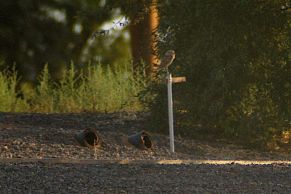
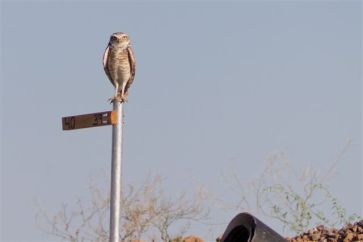
Greg Clark, Burrowing Owl Project Coordinator for Wild at Heart, introduces the ten burrowing owls to be released into Zanjero Park, Gilbert.

Volunteers are needed to help monitor our 10 initial burrowing owls that will we be releasing into Zanjero Park on 4/28.

We will be following the set scientific protocol for surveying burrowing owls relocated to artificial burrows.  This requires weekly observations alternating between morning one week and evening the following week. Therefore we are recruiting for two teams of volunteers; a morning crew and an evening crew.  This brings the volunteer commitment to every other week, but we will take volunteers whenever they can be available.

The morning time period is from sunrise up to 9 am and the evening period is from 5 pm up to sunset. We will be documenting # of adults and juveniles present, their band #’s, recording the burrow entrances associated with each individual, monitoring the reproductive status of nesting pairs, emergence and survival of young, fall and winter dispersement, and prey preferences.

If you would like to sign up or get further information contact

Stacy Burleigh is coordinating OwlWatch, a citizen science project documenting the burrowing owl habitat at Zanerjo Park, for Desert Rivers Audubon.

at stacymb@cox.net or 480-507-9177.

Burrowing Owl Release Picnic & Celebration

Saturday, April 28th, 8am-noon, bring a picnic lunch & enjoy the release of burrowing owls into Zanjero Park as we remove the tent and uncap the artificial burrows installed in October.

Your Yuma: Visit Another World in Southwestern Arizona (without leaving the East Valley) April 10, 2012

Henry Detwiler discusses southwestern Arizona natural History April 10th @ Desert Rivers Audubon's monthly meeting.

Tuesday, April 10, 2012, 7-8:30pm, Gilbert Community Center, 130 North Oak Street,  Gilbert, Henry Detwiler, past President of the Southern Illinois Audubon Society & member of the Arizona Rare Bird Committee, guides us through the natural history of southwestern Arizona. Detwiler is the author of Finding Birds in Yuma County, Arizona & co-author of Finding Birds at the Salton Sea and in Imperial County, California.
Finding Birds in Yuma County ArizonaCome early to browse our mobile book shop, visit, and discover volunteer opportunities with Desert Rivers Audubon. Learn about our Burrowing Owl Habitat opening at the end of April at Zanjero Park, Gilbert. We’ll brief everyone on our painting day at the Hummingbird Habitat at Desert Breeze Park, Chandler, April 14, 8-10am. Light refreshments served (last meeting until Sept.)

Rescued Flight: Raptor Rehabilitation with Desert Rivers Audubon, Liberty Wildlife & live birds, Tuesday, March 13, 2012

Desert Rivers Audubon Field Trips Director & Liberty Wildlife volunteer Susie Vaught with owl & friends.

Please join Desert Rivers Audubon and Liberty Wildlife for “Rescued Flight: Raptor Rehabilitation,” a presentation including live eagles, owls & hawks, Tuesday, March 13, 2012, 7-8:30pm, Gilbert Community Center, 130 N. Oak St., Gilbert.

The dedicated volunteers of Liberty Wildlife visit with rescued hawks, eagles and owls to demonstrate the resilience and care required of Arizona’s unique birds of prey. The physics of bird flight will be discussed.

This event is part of the 2012 Arizona Science & Technology Festival.

Come early to browse our mobile book shop, visit, and learn about volunteer opportunities with Desert Rivers Audubon including our Burrowing Owl release in Gilbert,  March 31, 2012. Light refreshments served.

Join Desert Rivers Audubon for the Great Backyard Bird Count February 17-20, 2012

Kick-off Saturday, February 18th @ Gilbert Riparian Preserve

Join Desert Rivers Audubon at the Gilbert Riparian Preserve at Water Ranch, 2757 E. Guadalupe Road Gilbert, to kick-off the Great Backyard Bird Count, Saturday, February 18, 2012, 8am-12 noon.

Watch birds for at least 15 minutes…

The goal of The Great Backyard Bird Count is to watch birds for at least 15 minutes on one or more days of the count then enter tallies. Anyone can participate, it’s free, and no registration is required. Participants can count anywhere they wish, not just in backyards, but in neighborhoods, parks, nature centers, or anywhere they see birds.

Wild peach-faced lovebirds

Submit your list…

“This count is so fun because anyone can take part — we all learn and watch birds together — whether you are an expert, novice, or feeder watcher,” said Gary Langham, Audubon’s Chief Scientist. “I like to invite new birders to join me and share the experience. Get involved, invite your friends, and see how your favorite spot stacks up.”

Get some local coaching…

Black-crowned Night Heron

“We’ll be able to coach East Valley residents in their bird identification skills Saturday during our free Family Birdwalk at Gilbert Riparian Preserve, Saturday, February 18, 2012, 8am-noon,” added Eileen Kane, Communications Director, Desert Rivers Audubon Society.

More than 92,000 checklists were submitted during the last GBBC, with more than 11 million individual bird observations. The data help scientists get the big picture about how bird populations may be changing across the continent over time.

…become a Citizen Scientist!

“This is a very detailed snapshot of continental bird-distribution,” said John Fitzpatrick, director of the Cornell Lab of Ornithology. “Imagine scientists 250 years from now being able to compare these data with their own.  Already, with more than a decade of data in hand, the GBBC has documented changes in late-winter bird distributions.”

Earn prizes, too!

The count also includes a photo contest and a prize drawing for participants who enter at least one bird checklist online. The GBBC is hosted each year by the Cornell Lab of Ornithology and Audubon. The Great Backyard Bird Count is made possible in part by sponsor Wild Birds Unlimited.

Bring your Great Backyard Bird Count count sheets into Wild Birds Unlimited of Mesa, AZ & receive 2 lbs. of birdseed!

Desert Rivers Audubon & Wild At Heart Dig In Wildlife Development for Burrowing Owls in Gilbert

By Eileen Kane
Communications Director
Desert Rivers Audubon

Greg Clark, Owl Habitat Coordinator for raptor rescue and rehabilitation group Wild At Heart, talked about the struggle to preserve Arizona’s Burrowing Owls,  September 13, 2011, at Desert Rivers Audubon’s monthly meeting.

Burrowing Owl visits Desert Rivers Audubon's September 2011 meeting, photo by Linda Covey.

A Species of Special Concern, Burrowing Owls live their lives largely in underground burrows made by squirrels, coyotes, skunks and other animals. Small and active both day and night, Burrowing Owls are vulnerable to other birds of prey, animals, and construction.

With over 5,000 artificial owl burrows installed throughout Arizona, Greg describds his latest project with Desert Rivers Audubon to install 100 burrows at Zanjero Park, Gilbert. Immediately adjacent to active farmland, Zanjero is an example of the disturbed land on the fringes of suburban areas Burrowing Owls prefer.

Desert Rivers Audubon is organizing volunteers to dig the burrows, 8am-2pm, Saturday, October 29, 2011 at Zanjero Park, 3785 S. Lindsay Road, Lindsay Road, South of Loop 202, Gilbert. In the spring, volunteers will again be needed to feed and care for the owls while they are acclimated to the site and before their release.

The Burrowing Owl Habitat Project is made possible by a grant from Together Green, an initiative by the National Audubon Society and Toyota to fund conservation projects, train environmental leaders, and offer volunteer and individual action opportunities that significantly benefit the environment.

Desert Rivers Audubon and Wild At Heart will also present a technology forum Wednesday, September 28, 2011, as part of the Gangplank Brown Bag Series lunchtime series. Both organizations are seeking advice and brainstorming on social media, mobile technology, and signage to enhance the public’s experience of this Burrowing Owl habitat.

UPDATE (10/24/2011) from Greg Clark:

“Zanjero Park is considered underutilized by the Town of Gilbert. It is designed for use by horses and there is evidence that horse owners do take their horses there for riding. But, it is not used much for that purpose. It has attractive recirculating water features and two well maintained ramadas that are occasionally used at lunch time by office workers. The main trail around the edge of the park is part of a larger trail used mostly by bicycles. This appears to me to be the main use in the park. There is a nice park bench area and plantings in one area in the middle of the trail.

“Because the park is devoid of grass it is not attractive to families with small children looking for a playground. For all these reasons the park doesn’t see much use. But, situated next to farm land, it is perfect for Burrowing Owls. The trail system and park bench would allow easy access to see the owls and small children would not typically be at the park running around and looking for fun opportunities to chase the owls. The low density vegetation will allow the owls good visibility, especially in the large basin area where the release sites are located. 100 burrows are being installed with four release sites.

“Once the owls are present the use of the park will go way up as people go to see the owls up pretty close.

“The close proximity of Campo Verde High School (adjacent to the park) could provide scientific and educational opportunities for the students via monitoring, owl behavior descriptions, pellet comparison studies with other nearby owl sites, and gathering video and still images for web site reports and creative writing.

“I anticipate that one release tent per year would go up for the next 4 years.”

UPDATE (11/14/2011) from Steve Thomas (conact stevepthomas@cox.net to volunteer):

If you missed #OWLDAY, Wild at Heart has another habitat install project, Saturday, November 19, 2011.

“On Nov 19th we will be constructing new homes for burrowing owls at a farm northwest of Gila Bend.  Travel time from Phoenix to the site is approximately 2 hours.

“The 400 new homes, or artificial burrows as they are called, are needed to relocate AZ burrowing owls who have been displaced by development and/or loss of their natural burrows and habitat.

“Building the burrows consists of placing plastic burrow chambers in the ground, connecting flexible access tubes to the chambers and creating ground-level entrances so the owls can get down inside their new home. We expect these new homes will support many families of owls for the next 20 years.

“Children are welcome at the event.  Children ages 10 and up can usually perform any of the tasks; children ages 8-9 can learn some of the more difficult tasks and be good helpers to an adult or teen. Children 4-7 may be able to paint the tubes and help carry supplies back and forth. Children under 4 will need constant supervision to be sure they stay safe.”

Greg Clark, Wild At Heart Burrowing Owl Habitat Coordinator, joins chapter president Krys Hammers and a rescued burrowing owl at Desert Rivers Audubon's September 2011 meeting. Photo by Linda Covey.

Give a Valentine to Wildlife: Eat Local

Wild peach-faced lovebirds

Audubon @Home, Arizona

by Krys Hammers
President
Desert Rivers Audubon Society

One way to reduce your carbon footprint is to eat local.  According to the website, www.eatlocal.net, the average distance that food travels in the US from the farmer to the final consumer is 1,518 miles.  The fuel used and the pollutants generated from trucking your food can be greatly reduced if you buy local foods.

Additionally, when you buy food directly from the source, the farmer gets $.90 of every dollar you spend. The farmer only makes $.21 on the dollar on food he sells to food distributors.  The rest goes to transportation and distribution.   In turn buying locally supports your local farmers and your local economy.  Foods that don’t go into the distribution chain are also less susceptible to contaminants.

The East Valley area hosts a number of Farmer’s Markets. Most operate seasonally and the season ends in June.  That’s the case in Tempe and Chandler, but the Mesa Farmers Market; located at 263 N Center operates year-round.  They are only open on Fridays from 9am to noon.

If you can’t get to a Farmer’s Market, you may want to consider participating in a co-op or CSA (Community Supported Agriculture). You pay a fee and each week you receive a bag full of fresh local vegetables, sometimes with recipes or ideas for using them.  You can also preserve some fruits and vegetables for use when they are out of season.

The ultimate in eating locally is growing your own food.  We all know how harsh our desert can be.

Winter vegetable garden at University of Arizona Maricopa Extension, Phoenix

Yet some fruits, vegetables and herbs are well-adapted to our climate.  The soils can be treated to be more productive.   It gives you a use for that compost that you’re creating.  It doesn’t take a lot of space.  It’s amazing how much you can get out of a 5 foot square raised bed.   And if you plan well, you can have 2 growing seasons a year.

I’m trying my hand at gardening for the first time in this climate.  I expect to have all the cherry tomatoes and cucumbers that I can use this summer.  And I’ll have more basil, rosemary and oregano than I can use.  Not to forget my feathered friends, I also planted a sunflower with a huge seed head, just for the birds.  It is so much fun when cooking to go out to the garden for some ingredients.   It’s fresher, and you know it’s got to taste better.  When you grow it yourself, you can know for certain if you have used pesticides or chemicals.  I recommend the book, Extreme Gardening by Dave Owens to help you get started.

Not everyone may want to grow their own food, but we can all support markets and restaurants that use local foods. I challenge you all to become a locavore and go on a 100 mile diet.  The next time you’re tempted to buy that cantaloupe that was shipped all the way from Argentina, think twice about what it truly costs us.

Follow

Get every new post delivered to your Inbox.

Join 524 other followers